Black Sabbath Rapidshare Discography Spine
On 12 April 2013, the band released the album's track listing. The standard version of the album features eight new tracks, and the deluxe version features three bonus tracks. The band's first single from 13, ', was released on 19 April 2013. On 20 April 2013, Black Sabbath commenced their first Australia/New Zealand tour in 40 years, to be followed by a major North American Tour in Summer 2013. The second single of the album, 'End of the Beginning', debuted on 15 May in a episode, where all three members appeared.
Well I made a rod for my own back here! I figured with me saying things were gonna be less about the 'rare' and more about the music I like well I decided it was time to tackle my two favorite bands and represent something on this blog that means a lot to me me musically, So let's start with Black Sabbath I knew doing a post on these sonic. A journey through the legendary heavy metal outfit's tumultuous discography. Black Sabbath featuring. Reads the spine of this unfortunate LP that was intended.
Ronnie James Dio left Black Sabbath in November 1982 to start, and took drummer Vinny Appice with him. Live Evil was released in January 1983, but was overshadowed by Ozzy Osbourne's platinum selling album. Born Again (1983–1984) The remaining two original members, Tony Iommi and Geezer Butler, began auditioning new singers for the band's next release. 's, and 's were considered and Iommi states in his autobiography that auditioned for the band. The band settled on former vocalist to replace Ronnie James Dio in December 1982.
Dio officially joined in June, and the band began writing their next album. With a notably different vocal style from Osbourne's, Dio's addition to the band marked a change in Black Sabbath's sound. 'They were totally different altogether', Iommi explains.
While working in the United Kingdom, new vocalist Ray Gillen abruptly left Black Sabbath to form with guitarist (ex-,, ). The band enlisted former vocalist to re-record Gillen's tracks, and former drummer to complete a few percussion overdubs. Before the release of the new album Black Sabbath accepted an offer to play six shows at, South Africa during the apartheid era. The band drew criticism from activists and artists involved with, who had been boycotting South Africa since 1985.
The band took time off in 1988, returning in August to begin work on their next album. As a result of the recording troubles with Eternal Idol, Tony Iommi opted to produce the band's next album himself. 'It was a completely new start', Iommi said. 'I had to rethink the whole thing, and decided that we needed to build up some credibility again'. Iommi enlisted former drummer, long-time keyboardist Nicholls and session bassist, and rented a 'very cheap studio in England'. Black Sabbath released in April 1989, and it was also ignored by contemporary reviewers, although AllMusic contributor Eduardo Rivadavia gave the album four stars and called it 'the finest non-Ozzy or Dio Black Sabbath album'.
The band then recruited an unknown Los Angeles vocalist named. The new line-up wrote and rehearsed throughout 1984, and eventually recorded a demo with producer in October. Unhappy with the results, the band parted ways with Donato shortly after. Disillusioned with the band's revolving line-up, Geezer Butler quit Sabbath in November 1984 to form a solo band.
'It was intolerable for me to get on the stage without Ozzy. And I drank 24 hours a day, my alcoholism accelerated'.
The original line-up lasted until 1979, after which Osbourne was fired and replaced. The line-up changes would continue, with no line-up remaining intact for consecutive studio releases. Throughout the changes, only Tony Iommi and keyboardist, who also joined the band in 1979, would remain with Black Sabbath, although Nicholls would not always be credited as a full member. In 1997, Iommi, Butler, Ward, and Osbourne reunited, touring and releasing a live album in 1998, although a long-rumored studio release did not appear (the group attempted to record a new album in 2001 with producer but the sessions were scrapped). After that, the group periodically reunited to tour with Ozzy's 'Ozzfest' tour. In 2004, longtime keyboardist Geoff Nicholls was replaced by for an Ozzfest tour. No reason was given for the replacement.
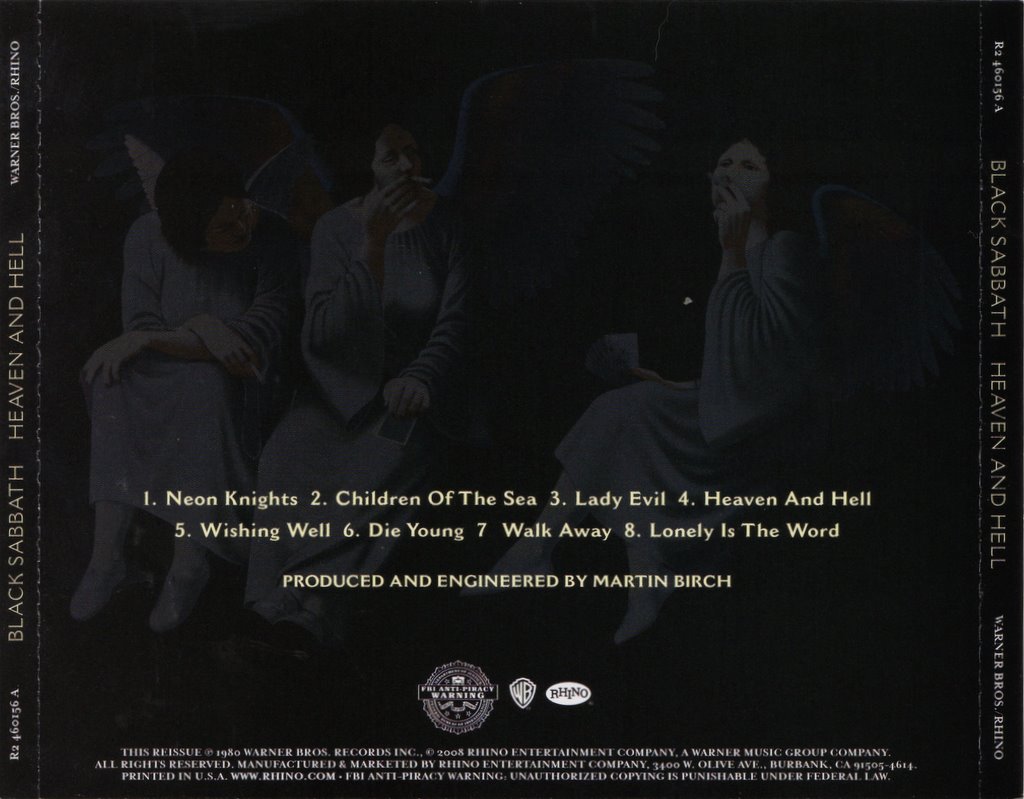
The Dio Years and Heaven & Hell (2006–2010). Tony Iommi in 2007 with Heaven & Hell While Ozzy Osbourne was working on material in 2006, released, a compilation of songs culled from the four Black Sabbath releases featuring Ronnie James Dio. For the release, Iommi, Butler, Dio and Appice reunited to write and record three new songs as Black Sabbath. The Dio Years was released on 3 April 2007, reaching number 54 on the Billboard 200, while the single 'The Devil Cried' reached number 37 on the Mainstream Rock Tracks chart. Pleased with the results, Iommi and Dio decided to reunite the 1981 Mob Rules era line-up for a. While the line-up of Osbourne, Butler, Iommi and Ward were still officially called Black Sabbath, the new line-up opted to call themselves Heaven & Hell, after the album of the same name, to avoid confusion.
Reunion (1997–2006). Black Sabbath on stage in on 16 December 1999, L-R: Butler, Osbourne, Iommi, Ward In the summer of 1997, Iommi, Butler and Osbourne reunited to coheadline the tour alongside.
Although initially 'despised by rock critics and ignored by radio programmers', the group sold more than 8 million albums by the end of that decade. Influence and innovation Black Sabbath have influenced many acts including,,,,,,,,,,,,,,,,,,,,,,,, and. Two gold selling have been released, Volume 1 & 2, including covers by,,,,,,, and. 's, who, along with bandmate inducted Black Sabbath into the in 2006, said 'Black Sabbath is and always will be synonymous with heavy metal', while Hetfield said 'Sabbath got me started on all that evil-sounding shit, and it's stuck with me. Tony Iommi is the king of the heavy riff.' Former guitarist said of the Paranoid album: 'There's just something about that whole record that, when you're a kid and you're turned onto it, it's like a whole different world.
The original Black Sabbath, from left to right:,, and Studio albums 19 Live albums 6 Compilation albums 12 Video albums 7 EPs 1 Singles 30 The following is the discography of, a British band. The band was formed in 1968 by (vocals), (lead guitar), (bass guitar), and (drums). The band has since experienced multiple lineup changes. Though the second most recent line-up of the band to work together were,, Iommi, and Butler, for three new songs for a compilation in 2007, the original line-up was still considered the 'current' lineup at the time and had been since their reunion in 1997. The 2007 sessions were deemed a one-off which led to the Heaven and Hell side project, resulting in a new studio album in 2009 entitled. In June 2013, a partial reformation of the original line-up released, which was the first album to feature Osbourne on vocals since 1978's. After 49 years together, Black Sabbath announced their breakup in March 2017.
Then you come back, and I bet you a billion dollars, he'd come up with a riff that'd knock your fucking socks off. Beginning with their third album, (1971), Black Sabbath began to feature guitars. In 1965, before forming Black Sabbath, guitarist Tony Iommi suffered an accident while working in a factory, losing the tips of two fingers on his right hand. Iommi almost gave up music, but was urged by the factory manager to listen to, a guitarist who lost the use of two fingers in a fire. Inspired by Reinhardt, Iommi created two thimbles made of plastic and leather to cap off his missing fingertips. The guitarist began using lighter strings, and detuning his guitar, to better grip the strings with his. Early in the band's history Iommi experimented with different, including C ♯ tuning, or 3 semitones down, before settling on E ♭/D ♯ tuning, or a half-step down from standard tuning.
1990 CD [ ] 1995 CD [ ] 2008 CD [ ] 1995 Cassette [ ] 1990 Cassette [ ] 1995 MP3 Download [ ] iTunes () Track Listing • Miracle Man • Bloodbath in Paradise • Shot in the Dark • Tattooed Dancer • Sweet Leaf • War Pigs NOTE: All tracks are live. Credits • Writing credits vary; see albums songs originally came from • Ozzy Osbourne – Vocals • Geezer Butler – Bass Guitar • Zakk Wylde – Lead Guitar • Randy Castillo – Drums • John Sinclair – Keyboards • Produced, Engineered, & Mixed by Andy Johns • 1995 Remaster by Brian Lee with Bob Ludwig Catalogue Numbers • 1990 CS Epic 6ZT-45451 • 1990 CD Epic ZK-45451 • 1990 CD Epic 45451 • 1990 CD Epic 45451 • 1995 CS Epic 67242 • 1995 CD Epic 67242 • 1995 CD Epic 67242 • 2002 CD Sony Extra Value 4815172 (Japan?) • 2007 CD Sony 786 • 2008 CD Sbme Special MKTS.
We would have had to focus a lot more on him.' In December 1997, the group was joined by Ward, marking the first reunion of the original quartet since Osbourne's 1992 'retirement show'.
• Ozzy Osbourne sings on two tracks (#3 & #7). Three, if you count the sound byte mentioned above. • The core band is what is listed above (There is a picture of them on the back cover of the CD). However, there are several tracks where there are multiple people on the same instruments. A complete listing would be rather lengthy. • Has many guest musicians. A complete list is on the CD cover, but the Black Sabbath related appearances are Ozzy Osbourne, Gordon Copley, Bob Daisley, Eric Singer, & Zakk Wylde.
Formed in 1968 as the Polka Tulk Blues Band, a blues rock band, the group went through line up changes, renamed themselves as Earth, broke up and reformed. By 1969, they had named themselves Black Sabbath after the film Black Sabbath starring Boris Karloff, and began incorporating occult themes with horror-inspired lyrics and tuned-down guitars. The band’s first show as Black Sabbath took place on 30 August 1969, in Workington. Signing to Philips Records in November 1969, they released their first single, “Evil Woman” in January 1970. Their debut album, Black Sabbath, was released on Friday the 13th, February 1970, on Philips’ newly formed progressive rock label, Vertigo Records. Though receiving a negative critical response, the album was a commercial success and reached number 8 in the UK Albums Chart, so the band returned to the studios to quickly record the follow up, Paranoid, which was also released in 1970.
I got really disillusioned with it and Gillan was really pissed off about it. That lasted one album and one tour and then that was it.' Following Butler's exit, sole remaining original member Iommi put Sabbath on hiatus, and began work on a solo album with long-time Sabbath keyboardist. While working on new material, the original Sabbath line-up agreed to a spot at 's, performing at the show on 13 July 1985. This event – which also featured reunions of and – marked the first time the original line-up had appeared on stage since 1978. 'We were all drunk when we did Live Aid,' recalled, 'but we'd all got drunk separately.'
Trashed (04:16) 08. Hotline (04:54) 09. In For The Kill (03:43) 10.
GOLIATH AND THE VAMPIRES 13. YOUR LIES BECOME YOU @320kbps Code: Monster Magnet - God Says No (2000) 1. HEADS EXPLODE 3. GOD SAYS NO 5. KISS OF THE SCORPION 6. ALL SHOOK OUT 7. GRAVITY WELL 8.
Sign to Seal and Deliver Fill in the fields for the seal, including a signer name, title and email address. You can copy and paste text into any of the fields on the window. You may also enter information to use as instructions for sealing. Corporate seal requirements by state.
Black Sabbath featuring Tony Iommi: reads the spine of this unfortunate LP that was intended to be a Tony Iommi solo album. It features none of original Sabbath lineup except Iommi; however pressure from the record label forced his hand. You can tell it’s not a Sabbath album when you listen to it; more vanilla hard rock than heavy metal. How to download dolby audio. Picking over Deep Purple’s scraps: New vocalist Glenn Hughes — also a former Deep Purple singer and bassist — replaced Gillan, who made a quick exit after Born Again. Average track length: 3:55 Best riff: “Danger Zone” Cover art deductions: It looks like an Iommi solo album, too.
Contents • • • • • • • • • • • • • • • • • • • • • • • • • • History Formation and early days (1968–1969) Following the break-up of their previous band in 1968, guitarist and drummer sought to form a heavy blues rock band in, Birmingham. They enlisted bassist and vocalist, who had played together in a band called Rare Breed, Osbourne having placed an advertisement in a local music shop: 'Ozzy Zig Needs Gig – has own PA'. The new group was initially named the Polka Tulk Blues Band, the name taken either from a brand of talcum powder or an Indian/Pakistani clothing shop; the exact origin is confused. The Polka Tulk Blues Band included slide guitarist Jimmy Phillips, a childhood friend of Osbourne's, and saxophonist Alan 'Aker' Clarke. After shortening the name to Polka Tulk, the band again changed their name to Earth (which Osbourne hated) and continued as a four-piece without Phillips and Clarke. Iommi became concerned that Phillips and Clarke lacked the necessary dedication and were not taking the band seriously. Rather than asking them to leave, they instead decided to break up and then quietly reformed the band as a four-piece.
No Stranger To Love (Remix Version) (From 7' Vinyl) (3:59) 04. Black Moon (1987 Original Version) (From 12' Vinyl Single The Shining) (3:39) 05. Some Kind Of Woman (From 12' Vinyl Single The Shining) (3:14) 06. Cloak And Dagger (From Promotion Cd Single Black Moon) (4:38) 07. Letters From Earth (Alternative Version) (From Tv Crimes Cd Single) (4:41) 08. What's The Use (Bonus Track From Japan Cd Cross Purposes) (3:03) 09. Loser Gets It All (Bonus Track From Japan Cd Forbidden) (2:56) 10.
In 1991, Iommi and Butler rejoined Dio and drummer to record (1992). The original line-up reunited with Osbourne in 1997 and released a live album.
There'd be a long intro that would go into a jazz piece, then go all folky. And it worked. Tony Iommi—and I have said this a zillion times—should be up there with the greats. He can pick up a guitar, play a riff, and you say, 'He's gotta be out now, he can't top that.' Then you come back, and I bet you a billion dollars, he'd come up with a riff that'd knock your fucking socks off. Beginning with their third album, (1971), Black Sabbath began to feature guitars.
Let's see what happens.' Musical style Black Sabbath were a band, whose music has also been described as, and. The band have also been cited as a key influence on genres including,,, and. Early on Black Sabbath were influenced by,,,,, and.
Anchored by the number 62 charting single 'Headless Cross', the album reached number 31 on the UK charts, and number 115 in the U.S. Guitarist, a good friend of Iommi's, played a guest solo on the song 'When Death Calls'.
STUDIO: 1970. Black Sabbath (1986, Castle, France, NELCD 6002) 1970. Black Sabbath (1987, Vertigo, Germany, 832 702-2) 1970. Black Sabbath (1987, Warner, USA, 1871-2) 1970. Black Sabbath (1989, Vertigo, Japan, 23PD-133) 1970. Black Sabbath (1991, Teichiku, Japan, TECP-23892) 1970.
• Format: CD, CS, LP 8 — 3 — 14 — 7 — — — 13 • UK: Silver • US: Platinum • CAN: Platinum 1973 • Released: 1 December 1973 • Label: World Wide Artists, Warner Bros. • Format: CD, CS, LP 4 — 4 — 49 — 6 — — — 11 • UK: Gold • US: Platinum • CAN: Gold 1975 • Released: 28 July 1975 • Label: Nems, Warner Bros. • Format: CD, CS, LP 7 9 14 — 44 — 6 33 — — 28 • UK: Silver • US: Gold 1976 • Released: 25 September 1976 • Label: Vertigo, Warner Bros. • Format: CD, CS, LP 13 — — — — — — — 33 — 51 • US: Gold 1978 • Released: 28 September 1978 • Label: Vertigo, Warner Bros. • Format: CD, CS, LP 12 — — — — — — — 37 — 69 • US: Gold 1980 • Released: 25 April 1980 • Label: Vertigo, Warner Bros. • Format: CD, CS, LP 9 — — — 37 — 22 44 25 — 28 • UK: Gold • US: Platinum • CAN: Gold 1981 • Released: 4 November 1981 • Label: Vertigo, Warner Bros.
It was like 'Rehearse today? No, we'll do it tomorrow.' It really got so bad that we didn't do anything. It just fizzled out.'
Additionally, the perception among fans of a return of some semblance of the 'real' Sabbath provided the band with much needed momentum. Sabbath began touring in support of Dehumanizer in July 1992 with,,, and. While on tour, former vocalist Ozzy Osbourne announced his first retirement, and invited Sabbath to open for his solo band at the final two shows of his tour in. The band agreed, aside from Dio, who told Iommi, 'I'm not doing that. I'm not supporting a clown.' Dio spoke of the situation years later: I was told in the middle of the tour that we would be opening for Ozzy in Los Angeles.
Black Sabbath Discography
Between Heaven & Hell The Best Of Black Sabbath (1993, Castle, Germany, RAD 8602-2) 1995. Between Heaven And Hell (1995, Castle, UK, RAW CD 104) 1996. The Best Of Black Sabbath 1970-1987 (1996, Teichiku, Japan, TECW-25352) 1996. (1996, Castle, 4CD, UK, ESF CD 419) 2000. The Best Of Black Sabbath (2000, 2CD, Castle, UK, RAWDD 145) 2000. The Best Of Black Sabbath (2000, Castle, UK, RAWPR145) 2006.
Formed in 1968 as the Polka Tulk Blues Band, a blues rock band, the group went through line up changes, renamed themselves as Earth, broke up and reformed. By 1969, they had named themselves Black Sabbath after the film starring, and began incorporating occult themes with horror-inspired lyrics and tuned-down guitars. The band's first show as Black Sabbath took place on 30 August 1969, in.
Butler convinced Iommi, who in turn broke up the current lineup, dismissing vocalist Tony Martin and bassist Neil Murray. 'I do regret that in a lot of ways,' Iommi said.
Much like many of their early contemporaries, the band received virtually no airplay on rock radio. As the band's primary songwriter, Tony Iommi wrote the majority of Black Sabbath's music, while Osbourne would write vocal melodies, and bassist Geezer Butler would write lyrics. The process was sometimes frustrating for Iommi, who often felt pressured to come up with new material: 'If I didn't come up with anything, nobody would do anything.' On Iommi's influence, Osbourne later said: Black Sabbath never used to write a structured song. There'd be a long intro that would go into a jazz piece, then go all folky.
A lot of bad things were being said from camp to camp, and it created this horrible schism. So by [the band] agreeing to play the shows in L.A. With Ozzy, that, to me, spelled out reunion. And that obviously meant the doom of that particular project. Dio quit Sabbath following a show in on 13 November 1992, one night before the band were set to appear at Osbourne's retirement show.
Apparently they are doing another album soon so we shall see but i personally thing there's little chance of them reedeeming themselves!! Thanks for your comment/opinion this has turned out to be a very interesting comments thread, Cheers, Dave B.
Black Sabbath performing in in 1981 Black Sabbath toured the U.S. Throughout 1980 with on the 'Black and Blue' tour, with a show at in filmed and released theatrically in 1981 as.
Following Butler's departure, newly returned drummer Ward once again left the band. Iommi reinstated former members Neil Murray on bass and Cozy Powell on drums, effectively reuniting the 1990 Tyr line-up.
Born Again (2011, Deluxe Ed., 2CD, Sanctuary, Germany, 2770406) 1986. Seventh Star (1986, Vertigo, Germany, 826 704-2) 1986. Seventh Star (1990, Vertigo, Japan, PHCR-2055) 1986. Seventh Star (1996, Castle, UK, ESM CD 335) 1986. Seventh Star (2010, Deluxe Ed., 2CD, Sanctuary, Germany, 2752472) 1987. The Eternal Idol (1987, Vertigo, Germany For Japan, 32PD-294) 1987.