Ir2110 Mosfet Driver Circuit Diagram
Thanks for your help. The ATmega8535 generating PWM, breadboard circuit of Full Bridge Inverter Output of the inverter, still in low switching frequency Output of the inverter, trying high switching frequency up to 20kHz now currently i designing my PCB with altium for this project. Btw, i read in the datasheet that 1N5818 reverse voltage rating is only 30V.
I am using IR2110 driver circuit to drive the 100 kHz H-bridge IRF640 MOSFET switches. I have attached the circuit diagram below 144829. What is the purpose of 2222N transistor in MOSFET driver circuit using IR2110 IC? From your circuit diagram and the attached wave-forms and after some analysis. Jan 20, 2013 Using the high-low side driver IR2110 - explanation and. Successful driver circuits with IR2110. 4 mosfet' and i want full circuit diagram of. I am doing my project on 9 level multilevel inverter. For this, I want a gate driver circuit for MOSFET and at the same time circuit diagram of 9 level multilevel inverter.
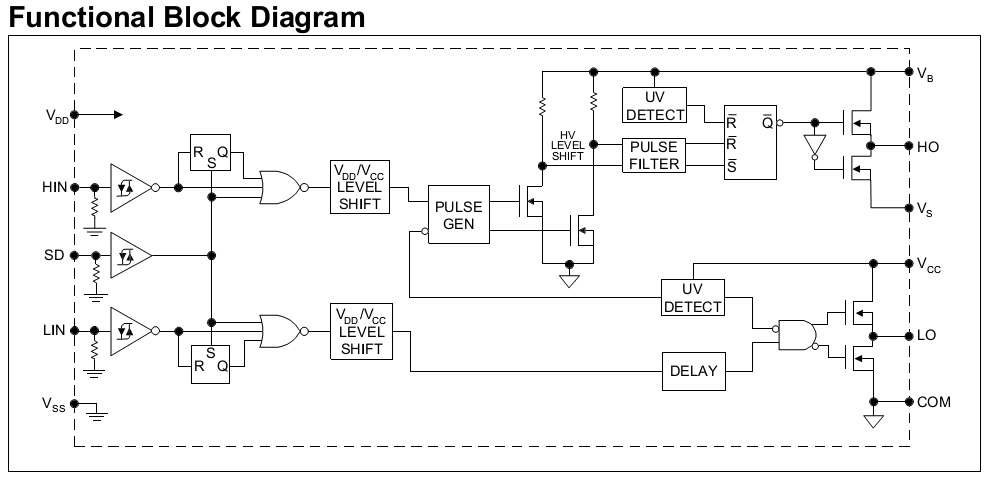
(IR2113) 20ns max. Packages Description The IR2110/IR2113 are high voltage, high speed power MOSFET and IGBT drivers with independent high and low side referenced output chan16-Lead International Rectifier Original. 54.24 Kb 1n2074aAbstract: DT98-2a Bootstrap Component Selection for Cont. This circuit has been implemented with the printed circuit board included in the IR2110 Bridge Driver, voltage differential measured between the gate pin of the power MOSFET and the drive pin of the IR2110, HV Floating MOS-Gate Driver ICs (HEXFET is a trademark of International Rectifier) Topics Covered, induction motor drives Push-pull and other low-side applications Driving a high-side P-Channel MOSFET How, DEVICES The gate drive requirements for a power MOSFET or IGBT utilized as a high side switch (drain International Rectifier Original. 187.03 Kb IR2110 application noteAbstract: IR2113 APPLICATION NOTE Data Sheet No. IR2110/IR2113 (S) HIGH AND LOW SIDE DRIVER Features, inputs VOFFSET ( IR2110) (IR2113) 500V max.
I have successfully designed H bridge after making many changes in H bridge with 33uf/50v bootstrap capacitor value. • For more detail I recommend you to go through data sheet of IR2210 and one tip for those readers who are from Pakistan, Don’t purchase IR2110 from Pakistan.Because low quality IR2110 IC’s are available in Pakistan which burn again and again and will make you hopeless.I have already gone through this situation while working on my final year project “Hybrid pure sine wave inverter”.Then I used IR2112 and its works perfectly. Because IR2212 and I2110 both are almost same and their pin out are same.I recommend you to use IR2112 also in your project. I want to design a micro controller based single phase H-bridge inverter. The whole circuit is made of PIC 16F877A, two IR2110 MOSFET driver, four IRF840 power MOSFETs plus the snubber circuits. I want to get pure 220V (Vrms) and 50HZ sinusoidal signal from an H-bridge after it is filtered. I write two 50HZ square wave (one for Low side and one for High side), which are 180 degree out of phase (Logic inputs to the H-bridge) to the first half of the H-bride and two PWM signal (5KHZ which are square wave), (one for Low side and one for High side), not simultaneously ON for both sides to the next half of the H-bridge using MikroC code.
This will cause high power dissipation in the upper MOSFETs. I suggest that those 0.47uF caps should be 0.1uF metal poly with a 10uF cap in parallel. You will likely find that your high-side MOSFETs run cooler. If Q1 and Q2 are both ON, or Q3 and Q4 are both ON, you have the dreaded 'shoot-through' condition, which shorts the power rails via the MOSFETs. Unpleasant things will happen.
Vs needs to be connected to the junction of the high-side MOSFET source terminal, which it is, but also to the low-side MOSFET drain, which it is not; as R13 is between the two. So, R13 is in the charge path for C4, the boost cap. However, since you are trying to turn on both MOSFETs simultaneously, I have my doubts about C4 attaining/maintaining a proper state of charge. Unless the low-side MOSFET is on by itself for some period of time, the boost cap won't get charged/recharged. Thank you so much for the reply SgtWookie, it is greatly appreciated. I have fixed the circuit diagram and I FINALLY got the HO driven for the high side MOSFET thanks to you advice. I now need to apply an inverting pwm signal to Lin (Pin 4) to get the low-side MOSFET driven as I only grounded it in the attached circuit diagram right?
If Q1 and Q2 are both ON, or Q3 and Q4 are both ON, you have the dreaded 'shoot-through' condition, which shorts the power rails via the MOSFETs. Unpleasant things will happen.
Hi, * please show a scope picture of your 'distortions' * where do you measure the distortions? Node in schematic. * what is the maximum duty cycle of your circuit? * you measure without load?
It’s a 55W light bulb. Instead, I’ll be using a current limiting power supply for the 12V rail.
Primary section of my step up transformer is connected to out pins as shown in fig-8. I am successfully getting 240 V AC at the primary by varying duty cycles. My transformer rating is 12V AC to 300V AC. But now if we think about the reverse direction means if I give I/P of 230V AC to secondary of transformer I am getting about 24V DC across drain of higher side MOSFETs and source of lower side MOSFETs while all the MOSFETs are in off state. I am using IRFZ48N MOSFETs. Now I want to charge my 12V DC battery which is connected across drain of higher side MOSFETs and source of lower side MOSFETs. Means battery is connected across 24V DC.
You now have current flow through RL, and a voltage drop across it that is roughly equal to the supply voltage. Turn off Q1 and Q4 Turn on Q2 and Q3 You now have current flow in the opposite direction through RL, and the voltage drop will be in reverse polarity from the last experiment. Note that Q1 or Q3 cannot remain ON indefinitely, as your 0.47uF caps will rapidly become discharged. This will cause high power dissipation in the upper MOSFETs.
Can you help me? And is there any way to get IR2110 in my library? Hi, Not 100% sure, but I think, when using a high-low side driver, both high side and low side MOSFETs can not be on at the same time. So, that may be your problem as LIN is connected to VCC. I'm also not sure if Proteus simulates high-low side drivers properly.
Because IR2212 and I2110 both are almost same and their pin out are same.I recommend you to use IR2112 also in your project. I want to design a micro controller based single phase H-bridge inverter.
Connecting all the grounds The breadboard has two power rails. I will use the left one for +12V for the VCC on the IR2110 and for powering the car light. The rail on the right will be +5V for the logic power supply of the IC and comes from the Arduino.
Go through this tutorial and then construct the correct circuit using the SG3525: Please upload your schematic to a file sharing site like rapidshare or an image hosting site like imageshack. Without looking at the schematic, it will be difficult to spot the problem. For the PIC16F684, you must ensure that the circuit and code are both correct. Once again, you should upload the code and the schematic so that I can take a look.
Hoping to hear from you to help me to resolve this matter asap and looking forward to see a bipolar square waveform on the left side of full bridge circuit. Regards dd77.
I still suggest that you try the circuit I posted, once. When you have it working and you play with it, I'm sure many of your doubts and questions will be cleared and answered.
Ir2110 Mosfet Driver Circuit Diagram
What am I doing wrong?? The datasheet used +15v for testing the high side, is 12v too low? When I measured my old inverter's base pin for the high side it said 60v @ 60 Hz and the Low side was 9V @ 60 Hz.
High Power Mosfet Circuit Diagrams
Becuase both MOSFETS are used in low side settings. Push pull dc to dc converter topology is used in this project. Iron core transformer is used in this circuit diagram. Ferrite core transformer are also used now a days in inverters design. In above circuit diagram Two MOSFETS are used. Remember to use separate heat sinks for both MOSFETS.
I turned on the power for a brief time because it is still al lot of current going through the breadboard and the tin aligator-clip wires. But it does work, I saw the car light go on and of with a slight delay compared to the pin 13 LED on the Arduino, this is because it takes some time for the bulb to heat up and cool down. Connecting external power source Conclusion The IR2110 is a cheap IC and can be used for high side driving as well a making half an H-bridge. However, I found it rather confusing for the datasheet to have the IC up side down, this is not how I use my ICs. In the near future I will be working on the IR2125 gate driver. It looks to be more intuitive in using as a single gate driver.
Here I place the bootstrap capacitors, its negative is connected to VS and the drain of the mosfet, the positive to VB to charge the gate when needed. Bootstrap capacitor Capacitors for the power rails Both power rails also get capacitors, this is to make sure the voltage supply is stable.
The carter 3 download zip. It is a pure sine wave inverter with a battery bank of 24V with an out 220VAC using a step up transformer.  I am using the configuration in figure 7 along with a PIC684 with the sine wave code. The output of the H-bridge seems to be good but I am having problems filtering the signal.